
The decisive court cases to close World War II’s final chapter have once again been dramatized, but the latest isn’t quite as strong as previous pieces of media.
The latest WW2 period piece takes place during most of the Nuremberg Military Tribunals after Germany’s defeat, with a focus on one of two main mental health professionals present during the process. That individual is Douglas Kelley (Rami Malek), a psychiatrist who spoke with the remnants of Third Reich who were imprisoned during the trial.
His most notable conversations were with Herman Goring (Russell Crowe), second in command to Adolf Hitler. As the film goes on, the discussions and analysis become more important as U.S. Justice Robert Jackson (Michael Shannon), the American lead prosecutor, prepares his case.
As mentioned in the lede, this isn’t the first movie covering this ground. There was “Judgement at Nuremberg” in 1961, which earned a Best Picture nomination from the Academy Awards, while Maximilian Schell won an Oscar for Best Actor.
The 2000 TV movie “Nuremberg,” meanwhile, was nominated for Best Film for Television by the Emmys and Golden Globes. Brian Cox also won an Emmy for his acting. Unfortunately, it’s doubtful that this flick will receive the same level of award attention.
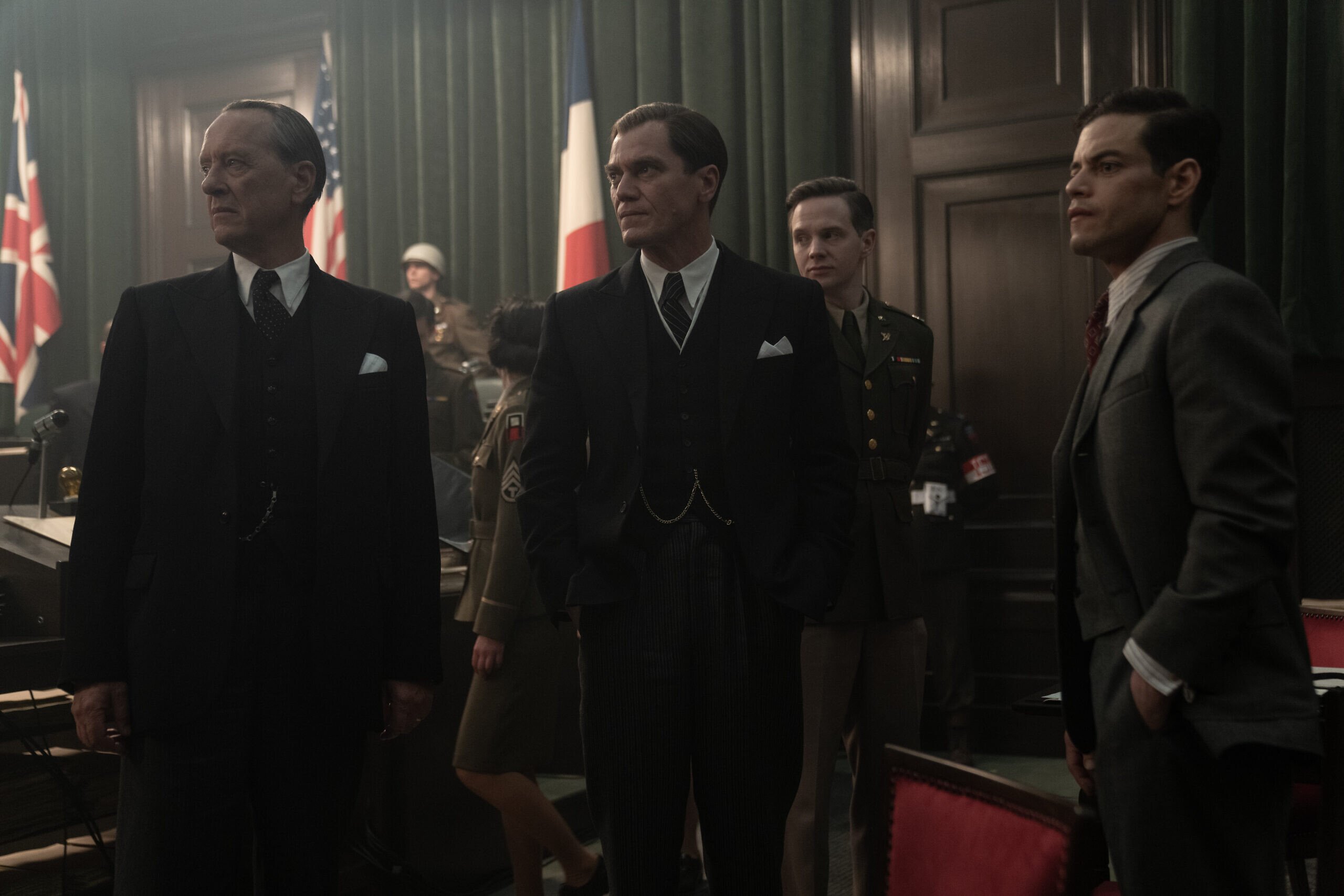
That’s not to say the 2025 “Nuremberg” is a total misfire. The movie has the proper look, with a muted color palette fitting the post-war aesthetic of the damaged German city, and there are fine performances, notably from Crowe and Shannon. However, the narrative structure is a foundational weak point.

The main issue with the film is how it wants to do two things at once, without really committing to either one. A good portion of this movie is centered around Kelley and his approach to speaking with the defendants. But at the same time, as its name implies, it also has to cover the trial.
But the movie, in totality, just covers a sliver of the Nuremberg procedurals, only dramatizing the moments where Goring was on the stand and largely glossing over the rest of the tribunal. It feels lacking in perspective for a movie wanting to provide a well-rounded view of this pivotal time in history, especially considering its title.
However, at the same time, it isn’t much of a biopic, either. The segments around Kelley ultimately feel uninspired. It’s not that his place in the story doesn’t fit. He is in plenty of scenes and he is certainly the protagonist. Yet by the end of the movie, it doesn’t feel like we were given a full portrait of who this man really was.
The audience is given some epilogue text where a viewer learns what became of him, but there’s not much beyond that. If the movie wanted to be a piece that really dug into his life, it perhaps could have done so while including some flashbacks to his time in Nuremberg. Instead, we get just a small portion of his life.
The result is a movie that wants to be a character study without being too studious, and cover a major trial without feeling like a true courtroom drama. By centering just on Goring’s time on the stand along with some preparation by the prosecution, the tribunal feels underdeveloped.
Say what you will about the 2000 made-for-TV picture. It was in fact somewhat bloated because of a romance that felt tacked on, and there were some historical inaccuracies.
But it set out to tell the story of the tribunal in a full, detailed way, and did it. An audience got to know all of the defendants, what their actual defenses were, how the Allied judges approached the trial and what the prosecution used in their arguments for justice.
This “Nuremberg,” doesn’t seem like it was as committed to either Kelley’s full lived experience, or the overall trial. For that reason, the flick largely suffers because the story lacks conviction. It doesn’t offer a comprehensive dramatization of the trial, nor does it provide a true understanding of the man.
Again, as mentioned earlier, this movie isn’t a train-wreck. There are scenes where the picture is really on point, like in moments where the prosecution has to determine how to legally take on the German command with little international precedent or when actual arguments are being made by the prosecution. Individually, there are several scenes that are compelling.
Those sequences are certainly benefitted by the likes of Crowe and Shannon, who are both solid as previously stated. As are Richard Grant and John Slattery who portray important side characters. Sadly, Malek actually ends up being the weak-link in the ensemble,
As a director and writer of this picture, James Vanderbilt’s efforts are hit and miss. There are positive aspects, but the execution for a cohesive picture wasn’t fully there. He wrote and directed the movie solo, and there’s a sense the project could have benefitted from a more involved producer or a co-writer experienced in historical drama. 3 out of 5.

 Matthew Liedke on Film