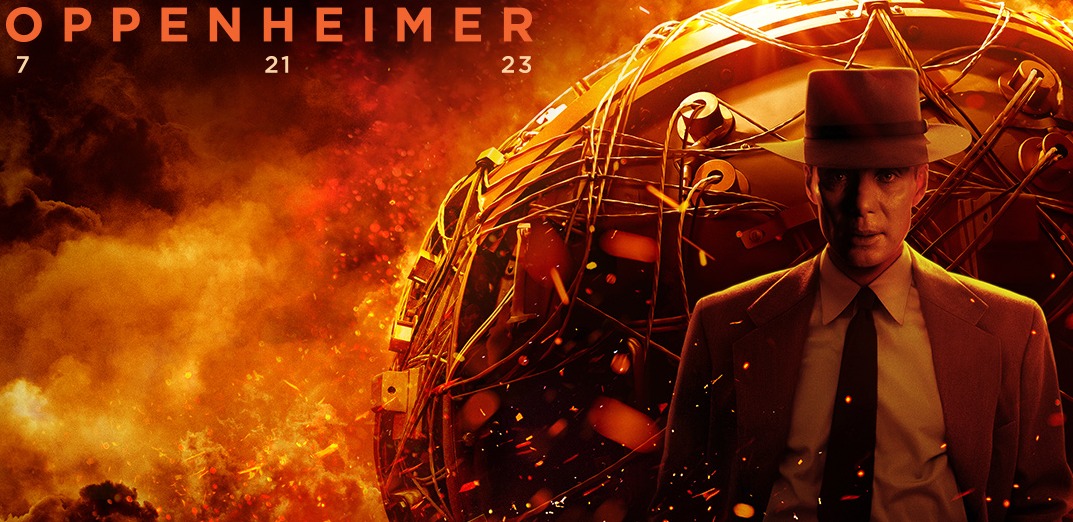
Scientific breakthroughs can be great things, leading to new discoveries and improvements in quality of life. They can also create terrifying, destructive power.
Christopher Nolan’s “Oppenheimer” captures the latter, and the impact it had on the figure that helmed such a breakthrough.
The film mainly revolves around J. Robert Oppenheimer’s work on the Manhattan Project, what led him to his involvement, and subsequent investigations into his character during the Red Scare. To do this the movie goes back and forth between three time periods.
Most of the movie takes place during the time where Oppenheimer was becoming a scientist and his work in Los Alamos. However, the movie also includes moments from Oppenheimer’s security hearing in 1954, as well as scenes in 1959 when Lewis Strauss’ hostile relationship with the physicist was brought up in commerce secretary nomination hearings with the Senate.
A true historical epic, Nolan’s “Oppenheimer” is a film that leaves no stone unturned when it comes to its main subject. It’s a deeply insightful look into a major player in world history, as well as a gripping political drama in the midst of war and conflict.
The sprawling three hour picture features a compelling character study, showcasing who Oppenheimer was as a man, scientist, lover, husband and military advisor. We as an audience see him from all sides, and it humanizes the figure beyond his work and historical significance.
That significance, though, is still very much shown on screen, and it’s captivating. Watching the lead-up to the Trinity Test, the immediate post-war period, as well as the hearings that follow for both Oppenheimer and Strauss, is engrossing thanks to sharp writing and impeccable artistry.
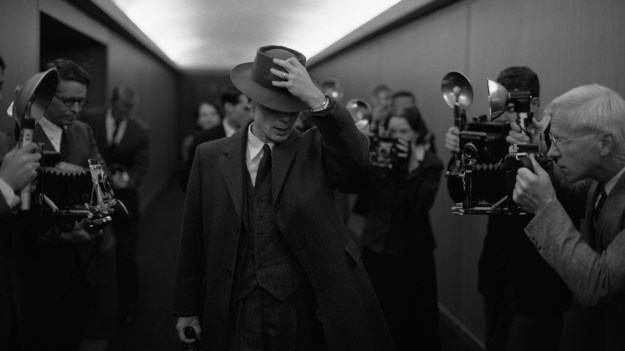
From start to finish, the film is completely enthralling because of how well the history is being dramatized, and it’s emotionally charged thanks to how the film shows Oppenheimer’s personal life. Part of what makes this work so well is how Nolan broke the film into the three time periods.
Admittedly, the film takes a bit of time to find its groove. The first bit of the movie is a lot to keep up with as three distinct time periods are set up at different stages of Oppenheimer’s life. Once things are established, though, the film goes from one time period to the next in great harmony.
Each time period is interwoven nicely with the other, and it provides more insight into the whole situation as well. The audience will see a moment during the Manhattan project, then the film will cut to Oppenheimer’s hearing where he or another is giving details on what they saw or how they felt.
The film will then add another layer by cutting to Lewis Strauss, former chair of the U.S. Atomic Energy Commission, who now finds himself on the hot seat for his work in dismantling Oppenheimer’s career. The cutting back and forth is done with a great deal of care, reminiscent of an Oliver Stone picture.

The film is also very nicely paced, with two distinct halves. The first is all a lead-up to the Trinity Test, with the suspense building greatly as the Los Alamos base is built, scientists are recruited and the work takes place.
There’s a clever visual guide in the form of a glass bowl being filled with marbles by the scientists every time they get more uranium for the bomb, adding to the tension as the moment gets closer and closer. The magnitude of the test is felt, too, through the discussions between the scientists and shots of the bomb being prepared and raised for its test. An audience can feel the historical importance of humans doing something never done before.
The rest of the film has a Frankenstein’s Monster feel to it. Oppenheimer is haunted by his creation and its potential for future use. That concern over future wars fought with the creation, though, what ends up being used against him as he’s hounded for alleged Soviet sympathies, as a viewer sees.
Oppenheimer’s whole character journey, including his tragic sidelining later in his career, is effectively brought to life on the big screen in large part thanks to Cillian Murphy’s award-worthy performance. As previously stated, this film dives deep into many aspects of the man, and Murphy is able to make the clearly complicated scientist relatable and highly interesting.
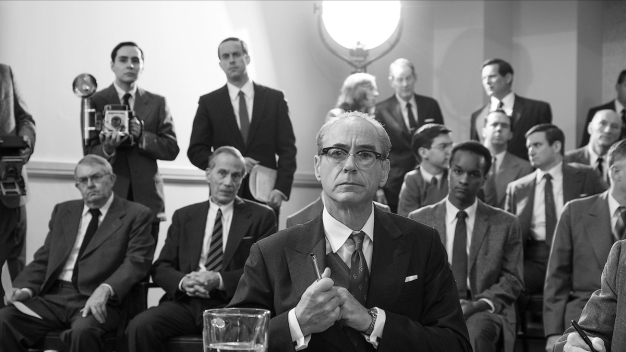
Robert Downey Jr., meanwhile, gives perhaps the best performance of his career as Lewis Strauss. The man’s bureaucratic sensibilities, his jealousy of Oppenheimer and greater willingness to develop stronger bombs as the arms race heated up is all convincingly portrayed by Downey. He has an especially great rant late in the movie.
Another admirable performance comes from Matt Damon as Gen. Leslie Groves. While Oppenheimer led the science at the Manhattan Project, Groves was in charge from the military perspective.
Damon doesn’t disappear into his character the same way Downey and Murphy do, but his straightforward approach to the general works. Groves is a practical straight shooter, and Damon’s businesslike portrayal fits. It’s also noticeable that Damon and Murphy have a chemistry on screen, and it’s reflected in how their characters develop a strong working relationship.
Emily Blunt also does great work as Katherine Oppenheimer, J. Robert’s wife. She clearly loves him, but she also has to deal with frustrations because of the scientist’s complexities and flaws, and that all is shown through Blunt’s work.
The supporting cast is really strong, too, with a great mix of actors doing solid work, including Jason Clarke, Florence Pugh, Rami Malek, Casey Affleck, Gary Oldman, Josh Hartnett and Kenneth Branagh.
The visual identity of “Oppenheimer” is incredible, too. The bomb testing scene is the main spectacle, but across the board, the film looks crisp and well shot. Both the grand scale moments in the desert and the smaller scenes in government hearings are visually strong thanks to creative camerawork and a lot of attention to detail.
The choice to have the time period centered on Strauss in black and white was good, too. It fits with how Strauss seems to see the world in a black and white way, while also giving the section an appropriate newsreel look.
“Oppenheimer” is an elite movie from Nolan, and arguably the best in his filmography. It’s a powerful, harrowing biopic full of great acting, phenomenal writing and insight into a scientific breakthrough that changed the world forever. 5 out of 5.

 Matthew Liedke on Film
One thought on “REVIEW: Nolan’s ‘Oppenheimer’ is an immaculate cinematic achievement”