
A story during the era of the French Revolution that’s gone largely untold is given a spotlight in this film.
It’s an admirable effort, although there’s a feeling it could have been stronger.
The movie centers on Joseph Bologne, the illegitimate son of an African slave and a French plantation owner who was raised to become a great violinist. Because of his skills, he finds himself in France’s high society, and is named Chevalier de Saint-Georges.
The movie picks up with Queen Marie Antoinette (Lucy Boynton) giving Joseph the opportunity to lead an opera house via a competition with another composer, to see who can write the best one. During that process, Joseph begins an affair with a married woman, Marie-Josephine (Samara Weaving). As this is happening, there are rumblings of revolution, and it will all come to a head.
The filmmakers deserve credit for highlighting a historic figure who certainly didn’t get the recognition he clearly deserved in the era. The movie validates his place in history both as a talented musician and a person who played a role in the French Revolution.
However, at the same time, there’s a sense that Bologne’s story doesn’t get the full cinematic treatment he deserves. While the movie captures the look of 18th century France, it has all the workings of a modern-day musical biopic.
In terms of story-telling, the movie has many of the hallmarks that have become all too common place in the genre. There’s a short moment showing the protagonist’s youth, his rise to stardom, a situation where he falls to rock bottom, followed by the moment where he rediscovers who he was, and has a grand performance at the end.
The inclusion of the romantic subplot and the connection to the French Revolution seem like they’re added as window dressing or just tacked on out of necessity, rather than being fully integrated parts of a multi-layered drama. It leaves a moviegoer really wanting a more compelling and cohesive experience.
What could have been a historical epic with political intrigue around the revolution, a musician breaking racial boundaries and dangerous romance feels boiled down to a more generic picture. It simply pales in comparison to other historical pictures like 1998’s “Elizabeth” or even 2018’s “The Favourite.”
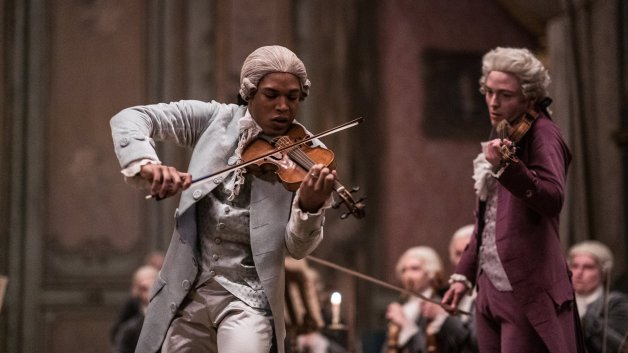
It’s a shame, too, because the crew did a great deal of work to make this picture look authentic. The set and costume design is exceptional, it’s clear to see a lot of care went into the work.. It’s period piece that feels lived in, the clothes and the castles are regal and the elegance of French high society is on full display.
Kelvin Harrison Jr., recently in “Cyrano,” turns in another solid performance as the lead character this time around. He captures Joseph’s ego, charm, resolve in the face of prejudice and eventually, willingness to take action. The rest of the cast, meanwhile, is serviceable, but not entirely memorable.
Biopics are a nice way to give a historical figure recognition, and “Chevalier” certainly does so with great attention to detail, bringing the era to life. However, the movie’s pedestrian narrative structure and lack of depth when it came to the historical events causes it to ultimately be disappointing. 2.75 out of 5.

 Matthew Liedke on Film
One thought on “REVIEW: ‘Chevalier’ gives insight to important musician, but does so generically”