
First “Lisa Frankenstein,” and now this. Yeesh.
Written and directed by Maggie Gyllenhaal, “The Bride” is a retelling of “Bride of Frankenstein.” However, rather than take place in the 1800s, this one is set in 1936 Chicago. The movie centers on Ida (Jessie Buckley), a young woman who is killed one night at a mob bar after she’s suddenly possessed by the spirit of Mary Shelley.
Meanwhile, Frankenstein (Christian Bale), the monster who took the name of his creator, has become exhausted from a century of loneliness and wants a significant other. With the help of a Chicago-based scientist, Dr. Euphronious (Annette Bening), they resurrect Ida, creating a wife for the monster. Their ensuing escapades result in havoc and chaos.
This is a film starring Academy Award winners Christian Bale and Penelope Cruz, Oscar nominees Annette Bening and Jessie Buckley, and Emmy nominee Peter Sarsgaard. Gyllenhaal’s directorial debut, “The Lost Daughter,” was an honorable mention in my end of year list in what was a competitive 2021.
Suffice to say, there was definite talent in front of and behind the camera, and there’s been plenty of works from them I’ve enjoyed over the years. That’s what made this viewing experience all the more disappointing. Sorry to report, but “The Bride” is an absolute disaster of a movie.
That’s not to say it’s bad that Gyllenhaal took a big swing with this. Going with a 1930s motif, in the midst of bootlegging and the days of John Dillinger, could make for a great backdrop for a thrilling monster romance. Unfortunately, what audiences get instead is a clunky, incoherent mess that has too much going on while having little payoff for anything.

The film gives off bad vibes immediately. Right at the start, we’re introduced to an undead Mary Shelley, also played by Buckley. She acts insane, rambling and shouting about how she wasn’t able to write her version of “Frankenstein.” But this, the movie unfolding before a viewer, is the real story she wanted to tell. It’s downright offensive, to put these words in this late woman’s mouth.
First of all, “Frankenstein” is one of the most honored works of horror fiction in history, to the point we’re getting adaptations more than 200 years later. But this makes it seem like that original story wasn’t sufficient. Second of all, why make her appear as this unhinged woman instead of the intelligent, idealistic person she was? It comes across as cheap entertainment value and an attempt to give the movie a “punk feminism” vibe.
But saying this movie’s effort to be an effective statement on feminism is like calling the commentary about mental health in “Joker” profound. It’s absolutely laughable. Oh, while we’re on this subject, this flick at many points felt like it was lifting heavily from the Joker and Harley Quinn portrayed in “Suicide Squad,” “Joker” and “Joker: Folie a Deux.”
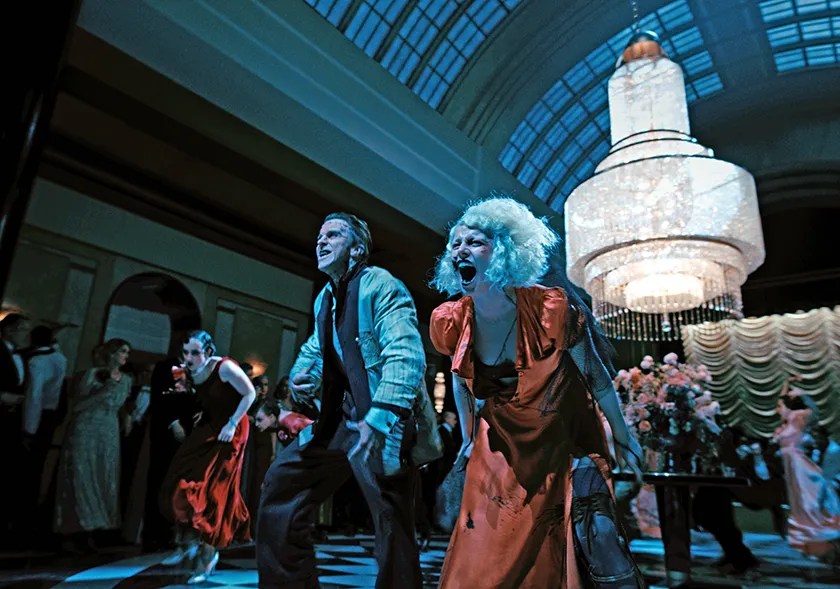
It’s this crazy couple engaging in crime and they’re oh so quirky. It’s a lot of that, and some random dance moments, including one that features the song “Puttin’ on the Ritz” straight out of “Young Frankenstein,” only here it’s played straight. It’s ridiculous, and there’s such little meaning in these dance sequences.
They’re meant to show the desires for life and self-expression both lead characters have. However, unlike, say, “Poor Things,” which also had a dance sequence, the scenes here lack a personality. It feels like these dance moments were there just for the sake of it, rather than honest, spontaneous bursts of emotion through physicality.
It’s part of a larger problem with the movie, in that it has a lot of ideas which are never fully fleshed out. This extends to the plot, too. There are so many things thrown into the story that it becomes jumbled. At points it wants to be a monster romance. In others a revolutionary picture centered on women’s rights.
Sometimes it’s a mob crime drama. It even becomes a detective procedural at times thanks to an entire subplot about a pair of sleuths. Yet none of this ever feels cohesive. The film sort of meanders, bouncing from plot point to plot point, over the course of its excessive two hour and six-minute runtime.
It doesn’t help that so much of the narrative and themes are spoon-fed to the audience through so much dialogue and monologue. There’s Shelley with her narration, plus the characters themselves, constantly telling rather than showing.
All of it leads to an ending with a bunch of gobbledygook, technobabble dialogue, followed by an attempt at an emotional moment that falls completely flat on its face. Then the song “Monster Mash” plays over the credits. Give me a break.
It doesn’t help that the character work isn’t any better. First of all, I hated how the monster took the name Frankenstein. It’s like. it purposefully misses the whole point of Victor Frankenstein himself actually being the monster for his disregard of ethics in playing with mortality, rather than his creation. But, OK, fine.
Putting that aside, Frankenstein doesn’t really work. There’s never a good balance with the figure. Sometimes he behaves simpler, just wanting a happy life like he’s watched in the movies. Other times he acts more aggressive, wanting to cause mayhem and upset the established order. There’s not a good medium formed.
Plus, Bale either does this weird, breathy voice, or screams and shouts. At points he reminded me of Brick from “Anchorman” yelling “loud noises.” It just becomes grating at a certain point.
We as the audience barely even get to know Ida as a character, meanwhile, before she early on in the movie becomes a caricature. Again, Buckley has proven she’s a capable actress in the past, and she gave one of 2025’s best performances in “Hamnet.” But she’s put in a tough spot here, with the split personality thing, and her approach is just to turn both up to 11. It simply becomes unfocused noise.
Side characters played by Saarsgaard and Cruz, as well as John Magaro who earned a Gotham Award nomination and starred in what I considered 2023’s best film “Past Lives,” feel wasted in rather forgettable roles. Bening, meanwhile, is the only person playing things too calmly, as she is what should be this film’s “mad” scientist. She’s just kind of a bothered scientist I guess?
As a period piece, one can at least notice that Gyllenhaal and company put work into capturing the look of that era. A person can also appreciate some of the makeup and hair work to bring these characters to life. However, visually, the movie is weak.
It lacks a real identity. It has a plain aesthetic, lacking flair, color and interesting cinematography that would match its energy. Again, an area where it falls short compared to the likes of “Poor Things.”
Big budget films where creativity and breaks from the norm are a good thing for Hollywood. But this was not it. “The Bride” is a cinematic wreck, stumbling from the outset and never manages to get up again. It’s uninteresting, unentertaining and struggles at finding anything to say despite its many ideas. 0.5 out of 5.

 Matthew Liedke on Film
One thought on “REVIEW: ‘The Bride’ is an abomination”