
The latest “Spider-Man” adventure is in the midst of a critical coronation, but unfortunately, there will be some rain on the parade in this review.
“Across the Spider-Verse” largely focuses on the character Miles Morales (Shameik Moore), a teenager juggling life as a private school student and as New York City’s hero Spider-Man. The movie picks up with Miles dealing with a new villain, the Spot (Jason Schwartzman), who has the ability to cross space and time through portals.
The villain’s power brings the attention of Gwen Stacy (Hailee Steinfeld), a Spider-Woman from another dimension introduced in the first film. Since then, she’s been working with other Spider heroes from different universes to maintain balance. Unfortunately, Miles’ newest villain starts a series of events putting Miles at odds with Gwen and other Spider heroes.
The first “Spider-Verse” installment was a really clever, fun and captivating animated film that offered a fresh take on a well-known character. In the time since that film came out, there have been a few movies incorporating the concept of multiple universes and this movie continues that trend.
However, when it came to the first film, the multi-universe aspect wasn’t the main feature, it was a tool. The movie was really about the young Miles finding his way as a hero, but with the added benefit of help from a diverse group of characters who truly understand him.
In the sequel, though, rather than being a tool to tell the story, the multiverse aspect has pretty much become the story itself. Gwen and Miles both have relationships in their lives that are impacted by their superhero antics that are compelling, but they’re so heavily tied back to the multiverse concept and the fates of Spider heroes all being connected. It simply becomes overwhelming and exhausting.
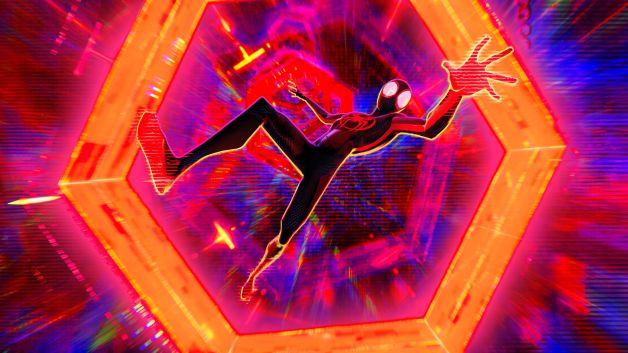
Every bit of Miles’ journey feels so bogged down by the excessiveness of the Spider-Verse and the meta aspect of each Spider-Man having the same lore, to the point where major life moments are referred to as “cannon events.” It’s understandable what the film is trying to do, but it becomes hard to care when the focus seems to have shifted from a more intimate hero’s story to a bloated, overstuffed mess.
Exploring the notion of destiny always has the potential to be interesting but the execution is off the mark this time. Having characters question their role in predicted events intrigues, but the depth of it all seems like it’s being sapped away as Spider-Man references and variations on the hero are constantly thrown at the screen.
It should be noted that the movie also ends abruptly, as it is part one of a duology. That in itself isn’t a problem, although the antagonist that seems to be set up for the sequel is based on a really overused idea at this point.
It’s all a real shame, too. Because when the film takes time to have smaller, character-driven moments, it’s quite endearing. Miles’ interactions with his parents or Gwen offer some genuine, heartfelt scenes that a viewer can really connect with.
It’s hard to say that moments with some of the new characters were as endearing, though. None of them really capture the imagination. For example, there’s a British rock music Spider-Man voiced by Daniel Kaluuya who wants everyone to know he’s an anarchist, as well as an Indian Spider-Man who guards Mumbai.
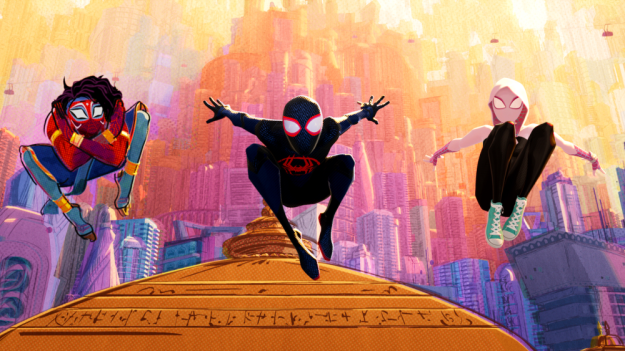
Both are Miles’ age and it could’ve been interesting if maybe they worked together more closely and bonded around being teen superheroes with the same powers, but they’re basically just there to show how they and their universe is different, and move on.
Another example is Spider-Woman, voiced by Issa Rae, whose one trait is basically that she rides a motorcycle. Cool? It’s all just such a downgrade from the first film.
“Into the Spider-Verse” didn’t just bring in various Spider heroes, it incorporated their different styles, from Peni Parker’s anime look to Peter Porker’s Looney Tunes aesthetic. Plus, not only were they all unique in how they looked, they also had much more distinct personalities.
One can at least admire the animation in the film. It remains a very creative format that sets itself apart from most animation studios other than, say, Laika. It’s a very expressive form of animation and really brings the movie to life. Although, there was a bit too much being splashed on the screen at times.
Miles and supporting characters from the first film remain likable protagonists this time around and the vibrant animation makes “Across the Spider-Verse” good to look at. However, the extensive multi-verse drama becomes mind-numbing and the new characters introduced are a let down, making for a disappointing two hour and 20 minute experience. 2.25 out of 5.

 Matthew Liedke on Film
One thought on “REVIEW: New ‘Spider-Verse’ is a disappointing slog”