
Not too long ago, I finished watching “The West Wing” for the first time.
Yes I was very late to the party on that one, seeing it more than two decades after it first aired on NBC. It was a very enjoyable watch, though, providing a fast-paced look into day-to-day politics.
It’s true that the show’s enjoyment can vary in terms of where one’s politics align, some finding it too left wing, and many seeing it as not left wing enough. However, what really hooks a person in at the end of the day with the show were the characters and the drama unfolding between them.
Now, while I hadn’t watched “The West Wing” for the time I’ve been writing on this site, I have reviewed plenty of political flicks, and watched many more released before that time.
So here’s a simple list of some movies in the political sphere that I’ve found to really get the genre right.
The American President (1995)

“The American President” is sort of like the beta version of “The West Wing.” The movie was directed by Rob Reiner, but written by Aaron Sorkin, and creative stylings from the latter are definitely there. The snappy, back-and-forth dialogue is there, as is the center-left and far-left factions in American politics trying to find common ground in order to advance an agenda.
Additionally, Martin Sheen, who plays the president’s chief of staff in this film, would go on to star as President Jed Bartlet in Sorkin’s “The West Wing.” Despite all the politics at play, though, what really makes “The American President” a winner is the same thing that made “The West Wing” work, which is the exploration of the characters as people.
Whether a person finds themselves in the same lane as this White House in policy or not, a viewer can appreciate how the president, and those around him are humanized.
Darkest Hour (2017)

“Darkest Hour” is a race-against-the-clock movie, but taking place in the corridors of power full of political back-and-forth. The threat of Germany attacking is getting closer to becoming a reality and the film shows how a complicated man stood by his convictions in the face of a major challenge.
It’s an engaging enough for a political drama, but what really powers it to a higher level is Gary Oldman’s mighty performance as Churchill. He is fierce, powerful and uncompromising.
It’s less a film about making brilliant maneuvers and more about how a leader used his booming presence to rally a nation. The final scene featuring the address to Parliament is masterful. Deservedly, Oldman won an Oscar for his work.
Dave (1993)

“Dave,” like other movies where a regular person is thrust into corridors of power, wins over audiences by seeing the protagonist find success by relying on their everyman charm. The movie is at its best when the titular character Dave uses his temporary position to do what’s right.
His actions include finding money in the federal budget to fund a homeless shelter, pushing for an employment plan, exposing government corruption and overall showing how the presidency can represent the best American ideals. Dave’s romance with Sigourney Weaver’s character, as well as the humor from his friendship with the Secret Service agent Ving Rhames adds personality.
But it’s the righteous effort Dave takes while filling in as president, and after when he exits the role while maintaining the dignity of the office, that makes this really enjoyable. It’s also quite lighthearted, which one can appreciate when considering how nasty politics can get.
The Death of Stalin (2017)

Armando Iannucci did exceptional work helming a film that is laugh-out-loud funny in many moments, while at the same time being constantly shrouded in a dark atmosphere. The wit in the writing is hilarious, but the film also consistently reminds the audience the awful circumstances that existed in the Soviet Union.
Making the film even more hilarious was how straightforward the acting was, with Steve Buscemi, for example, using his natural American accent as he navigates Soviet politics. The whole ensemble is fantastic, too, delivering phenomenal awkward comedic moments in one scene and making dead serious interactions work in the next.
It’s a fascinating look into a cutthroat political system where one always has to stay one step ahead, and it’s made all the better because of how it satirizes that very system.
Downfall (2004)

How do politics play out in a fascist system? What do the politics of a country look like when a nation is on the brink of collapse? “Downfall” answers those questions, with an in depth look at the final days of the dastardly Nazi regime in Germany.
The movie is largely set in the Führerbunker, with Adolf Hitler and his inner circle scrambling as the consequences of their evil actions begin to close in on them in the form of the Allies. The film dramatizes in precise fashion how the Third Reich fell apart, and in doing so, exposes the Nazi circle for what it was.
Underneath all of the political posturing about making Germany better, the Nazi party, was just a group of selfish, xenophobic, racists willing to commit atrocities and let their own country be destroyed to advance their insane agenda. “Downfall,” a well-crafted film, gets this point across.
Frost/Nixon (2008)

There are many great journalism films and many cross into political territory based on the nature of what reporters have to cover. However, journalism films are at their core about, well, journalism. The hunt and chase for a story is what captures one’s attention. That’s why I’m mostly not including films such as “All the President’s Men.”
However, I do think “Frost/Nixon” fits in on this list, as it’s less a journalism movie and more a one-on-one conversation about one of America’s biggest scandals. In a towering performance, Frank Langella portrays a Richard Nixon several years after his resignation from the presidency.
The film is largely summed up in the dramatic line by Nixon, “when the President does it, that means it’s not illegal.” The rest of the movie is certainly worth seeing, though, for its superb supporting cast and many great dialogue-heavy sequences where a complicated Nixon is held accountable
The Ides of March (2011)

I remember being excited to see “The Ides of March” because of the cast alone. Check out this roster: Academy Award winners George Clooney, Marissa Tomei and the late Philip Seymour Hoffman, as well as Oscar nominees Ryan Gosling and Paul Giamatti, plus Golden Globe winner Jeffrey Wright.
It lived up to the hype. Taking place during a campaign, “Ides of March” digs into the type of political activity before someone is even in office. Dealing with the media, working to top the competition, betrayals and a scandal are all featured in this engaging drama with good acting left and right.
What the movie really does is show how dirty of a game political campaigns can be, and how the system can sap away the optimism from even the most idealistic people.
Lincoln (2012)
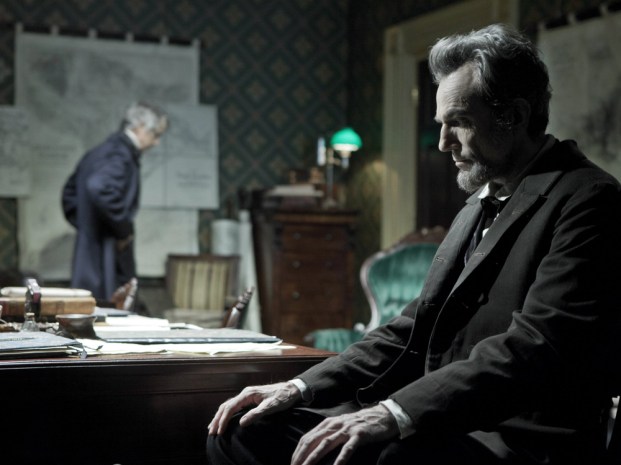
Recent presidencies have shown that it is not easy for the White House to get major legislation through both chambers of the United States Congress. That process was detailed in director Steven Spielberg’s fantastic 2012 film “Lincoln,” where the stakes were incredibly high.
With the Civil War raging on in its final years, “Lincoln” shows the soft-spoken, but strong-willed president using everything at his disposal to get the Thirteenth Amendment through Congress.
The movie details how he had to bring together the caucuses of his own party and even rely on some from across the aisle. All the while, the movie paints a personal portrait of the president, examining who he was, and this was helped by a phenomenal performance by the great Daniel Day Lewis.
Nixon (1995)

A political epic, “Nixon” is a full portrait of the man who was the 37th President of the United States. Full of Oliver Stone’s notable style, with a huge scope and captivating editing, “Nixon” gives a detailed depiction of the figure’s rise and fall journey.
An encompassing character study, Stone’s “Nixon” gives insight into the former president’s youth, political failures, eventual success, paranoia and the actions that led to his downfall. It’s a fascinating look at the complex and flawed person who is still one of, if not the, face of government corruption in the U.S.
The movie offers a deeper understanding of the man, but not in a way that exonerates him of his wrong-doing. Stone holds Nixon accountable in the movie, letting viewers know the consequences of his domestic and foreign policy beyond Watergate, but doesn’t forget to show the human side of the president.
Thirteen Days (2000)

Likely the most straightforward picture on this list, right down to its title, “Thirteen Days” is a dramatization of the Cuban Missile Crisis, and a damn good one. Full of political intrigue, with President Kennedy having to find the right solutions to ensure the nation is secure, without war breaking out.
This is shown with the president working alongside his brother Robert, as well as his trusted advisor Kenneth O’Donnell as they push back against hawkish military leadership and rely on intense diplomacy. The result is suspenseful drama where one is engaged, even though the outcome is very well known.
Again, this is a frank film that’s very much a procedural. However, it’s one that’s running at a really high level with a solid recreation of the historical event, highlighted by two strong performances by Bruce Greenwood and Kevin Costner as JFK and O’Donnell, respectively.

 Matthew Liedke on Film
One thought on “Ten Powerful Political Films”